Yesterday, June 6th, marked eight decades to D-Day, the largest amphibious invasion ever, the most extensive operation of the most significant war of our times. A turning point so pivotal that it shaped the rest of the war and the century after it. It decided the outcome and, by doing so, created the world order as we know it, one that we see crumbling today.
How does it matter, though? Now it’s the 80th and will be a century in two decades. Each of the 365 days in a year may commemorate some or the other event of the war. Plus, WWII, including and especially D-Day, is the most explored, represented, and talked about historical event in pop culture. What else is there to add? Analyzed and dissected repeatedly, it has reached a point of general apathy. The only new thing I can add is a story of my fascination with it.
And why do I care? I am an Indian born in 1990, as far in space and time from these events as one could be. Why should I care? I don’t know, but I have an idea of why it started and why my obsession refuses to wane. And to untangle it, to explain it even to myself, I need to write. So here we go…
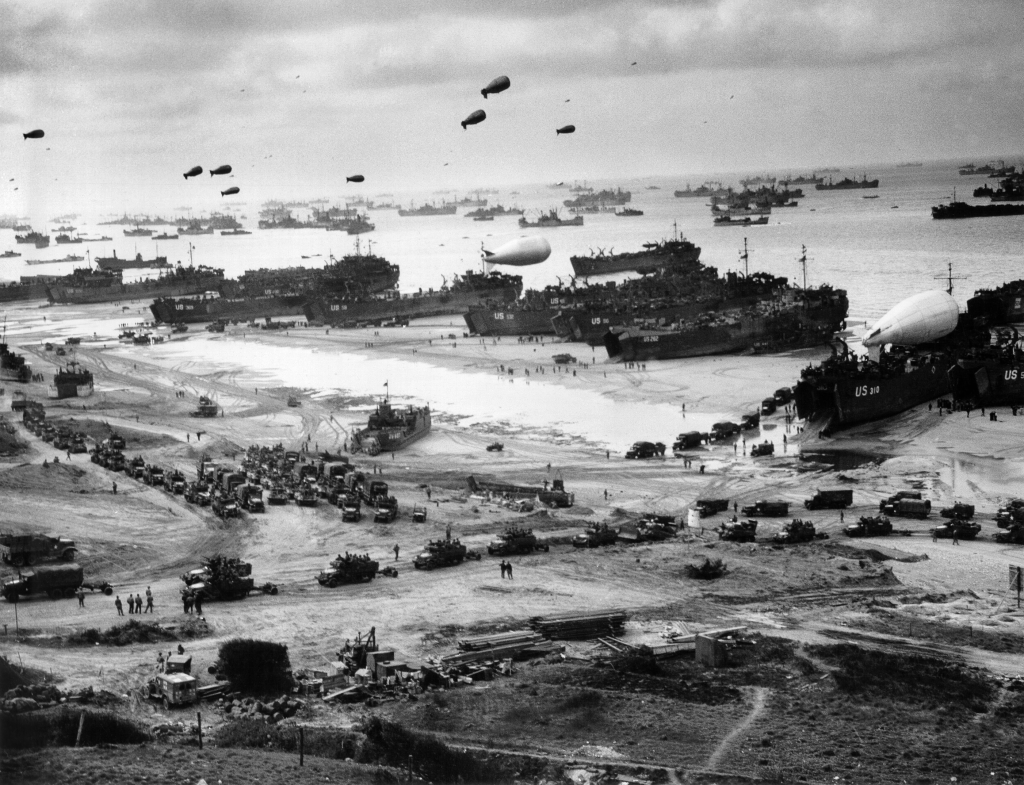
Just look at that!
Before I watched Saving Private Ryan or Band of Brothers, around 2000-2001, I played my first World War 2 game, Commandos: Beyond the Call of Duty. There was some archival, grainy WWII footage that accompanied each mission’s briefing, with rousing music, solid military jargon, and booming ‘commander’ voices. You led a team of the titular commandoes on stealthy missions behind enemy lines. The game wasn’t very realistic because no true mission would send four men against an army of hundreds. But then, that was the draw – sneaking around enemies who all had unrealistically horrible eyesight, distracting them with packets of cigarettes (yes!) so you can infiltrate whatever they walked away from, and overall, creating havoc in enemy camps and lairs. The German SS or SA guards with an IQ of 12 ran around like headless chickens looking for you. It wasn’t easy, but just tough enough to make you feel like a badass if you solved the challenge(s). The game is still available, and it’s still awesome. But what stayed most was that slow-motion, black-and-white footage from the 1940s, of marching Nazi soldiers, a shouting Hitler, destroyed villages, and real explosions.
A couple of years later, I remember getting a new PC, our second ever. For the time, it was the best PC we had among all my (four) gamer friends. Pentium 4 Dual Core, 128 MB of RAM, and a whopping 256 GB of hard disk space! We skipped our tuition that evening and played the first (for its time) graphic-intensive game on it – Call of Duty (1). CoD, we called it.
The bug that bit me that evening has eventually led to this post today.
The game was something else. After some training – which had quotes from real generals and historical personalities (Montgomery, Eisenhower, Patton, et al.) – you were airdropped in German-occupied France via parachutes in the middle of the night. It was the eve of D-Day. As a 13-year-old in the pre-social media era, when the Internet was still about MSN, Altavista, Yahoo mail, Hotmail, UltraIndia, and IndiaFM, I had no real idea what D-Day was. It was a word I had heard in the other game, too, but who cared? We had a precious few hours before ‘tuition’ ended, and my friends needed to go home. And this game was too good. That’s what mattered.
No more bird’s eye view of toylike soldiers sneaking around to avoid landmines, no more starting the mission after getting comfortable with the area’s geography, and no more planning strategies in advance. No. This, Call of Duty, was all in first-person; you looked down the barrel of your gun. And you were put straight in the middle of battle, in the heat of action.
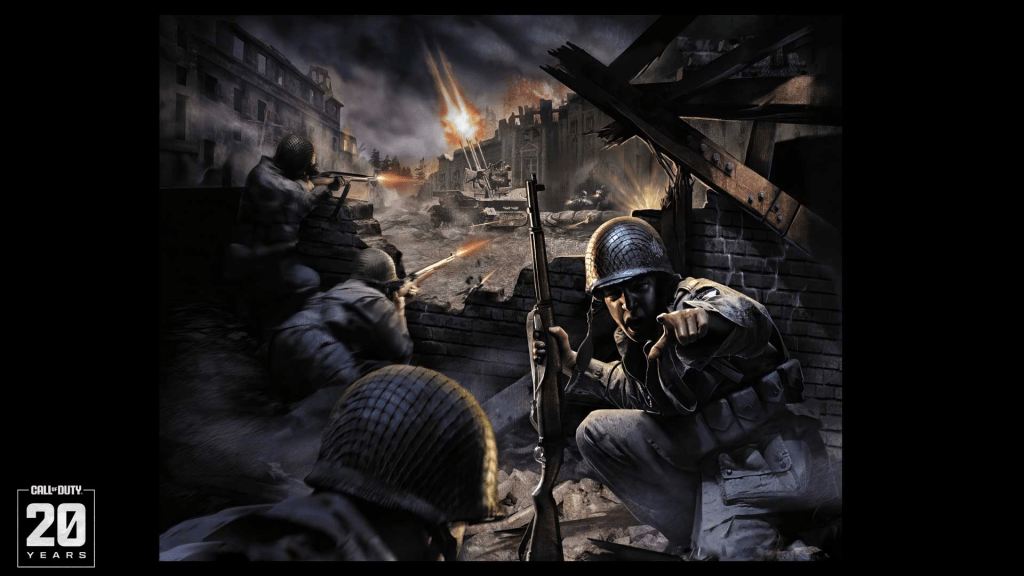
But the first mission starts quietly. It’s nighttime. Your parachute lands in a field, bristling in the breeze as you swoosh down smoothly. You gather it up and dump it. The only sound is crickets and your footsteps. You have a marker on your compass that points to an objective ahead. It is an idyllic French village at night, with a beautiful moon illuminating the scattered clouds as a low wind rustles the leaves on nearby trees. You sigh and look around. The grass is so natural! The lighting and reflections are so authentic. Your first task is to set up a radio beacon to let the planes know where to drop more soldiers. Along the way, you see the corpse of a fellow paratrooper, hung on a tree, tangled in his own parachute. You look at it as the adolescent you are. The adult in you wants to pause and feel the moment, get a picture of what it must’ve been like for hundreds of soldiers that night. And the teen in you wants to march on to the action. The teen wins, and you walk on.
That’s how it starts. And a few minutes later, all hell breaks loose.
A loud blast above you tears the sky open. The clouds are now lit up by constant anti-aircraft fire, the ground is shaking from mortars that form 15-foot-long craters around you, and the houses nearby are blowing up or trying to blow you up. And there you are, stunned, in the game and for real. You, who have never played anything beyond the wonderful fantasy of Harry Potter, the puzzle-like Commandoes, or the arcade Need for Speed, stand there a second longer than needed, disoriented, trying to find what to do and where to go. The next thing you hear is a couple of bullets whizzing past, and before you know it, you are shot dead by an unknown bullet from an unknown direction. The game restarts.
That was also the first time I ‘experienced’ shell shock – as soon as something exploded close by, the visuals blurred, the sound muffled, and you, the player, felt dizzy for a few seconds. The locations were accurate. All the guns and their sounds were real. The missions were based on history, and the world was massive & glorious. There was never a better, more sonorous cacophony – the battle cries, the air raid sirens, the mortars behind you, the MG42s (machine guns) firing from the front, and the roar of planes above, some crashing, some shooting, and some dropping parachutes that landed near you. You were the 82nd or the 101st Airborne. I don’t remember which, but now I know these two paratrooper factions were the first to be airdropped in France to help prepare for the impending D-Day invasion at Utah Beach.
That was it. The game unlocked the 40-year-old in me, for I have since then been fascinated by the history of World War 2 and by history in general. Following this, I got my hands on anything and everything related to WWII for the next decade or so. Basically, wherever Churchill roused his men to fight in his iconic speech—beaches, landing grounds, fields, streets, hills, sea, land, and air—I fought, too.
‘Medal of Honor‘ (MoH), ‘Hidden & Dangerous,’ and ‘Company of Heroes‘ were other games set around WWII that I played. After watching ‘Saving Private Ryan,’ I realized where CoD and MoH got their templates from. After playing CoD-2, 3, and 5, I learned more about other theaters of the war – like how painful the Russian campaign in the east was, how drawn-out Stalingrad, how cruel were the Japs in the Pacific theater, and how relentless the barrage on Omaha beach on June 6th. I watched ‘Band of Brothers’ and ‘The Pacific’. I liked Michael Bay’s ‘Pearl Harbor‘ (yes, I know). I enjoyed the films ‘Enemy at the Gates, ‘Stalingrad,’ ‘The Longest Day’, and ‘Fury.’ I loved it when Clint Eastwood made twin/sister films set around the same events – ‘Flags of Our Fathers‘ from the American/Allied side and ‘Letters from Iwo Jima‘ from the Japanese POV. The latter was my first foreign-language film.
There was spying, too, alongside all the action and adventure. I watched ‘The Imitation Game‘. I read about Operation Mincemeat and Operation Fortitude. The former was where the Allies planted a corpse carrying false documents on the Spanish coast in 1943 to deceive the Germans about the Allied invasion of Sicily! Fortitude was the deception operation to fool the Germans into thinking that the significant invasion would not be at Normandy but across the Strait of Dover at Calais. For a teenager and an action buff, all this is stranger and more thrilling than fiction. Multiple exciting operations, such as Operation Market Garden, failed, too. Watch ‘A Bridge Too Far’ for that one.
D-Day was incredibly fascinating because it was, as I learned, also called the Longest Day. The operations’ logistics, planning, and execution needed thousands of men, other than the ones on the frontline, to coordinate and cooperate. Several hundred departments had to work in tandem. There were last-minute weather delays. From west to east, these Normandy landings were broken into sections of beaches called Utah, Omaha, Juno, Gold, and Sword. Each had sub-sections with multiple objectives assigned to each faction. There was aerial support and naval bombardment. By nightfall, 160,000 Allied troops were ashore, with nearly a million more men on the way. The vehicles numbered around 7000, and there were about 9000 airplanes, all in a day.
The conquering & setting up of the beachheads was just the start. Tanks, more personnel, hundreds of other vehicles, medical facilities, supplies, and communication equipment had to be brought on shore, and they had portable docks to do all that. Everyone & everything had to be operating at their best, and yet, there were bound to be failures and mishaps and unforeseen calamities, for which hundreds of contingency plans had to be in place. The troops were trained for all that, had prepared for months, and yet knew that everything would still be instinctual once the landings began. Chaos would reign, and it did. But the mettle of those men persisted, helping them convene with soldiers from other regiments and teams to form makeshift armies, all headed for the same goal – to defeat the evils of Nazi Germany. It was called a miracle. They were 17-23-year-old boys, as old as I was when I feasted on WWII media!
And while WWII was fodder for the most thrilling action in pop culture – books, movies, and games, there was also the Holocaust. ‘The Pianist,’ ‘Life is Beautiful,’ ‘Schindler’s List‘ enraged me. The more I learned about the genocide, the more I wanted to read, watch, and play stories of the heroes on the good side. Yes, I loved the grime, blood, adventure, and dirt. But I wasn’t oblivious to its horrors, albeit too young to register their depth and magnitude. I hadn’t watched the harrowing ‘Shoah’ yet. At that time, it was easier to take sides and grunt for the good guys because the bad ones were all evil, like how evil was in books. EVIL evil. There were no two ways about it. No grey shades. It was a good fight, a righteous one. It is an easy war for young people to understand or to at least get into.
My WWII knowledge kept growing, and the sources were assorted. Growing up, I ventured into books and documentaries. Apart from the few good ones on Netflix, I recommend a BBC one. Lawrence Olivier, a Shakespearean thespian, has narrated the best documentary on the war, a 1973 BBC series called, ‘A World at War.‘ And recently, I have been reading Inferno by Max Hastings. There are plenty of WW-II episodes in my podcast-app history. I have twenty more books on it that I’ve started and abandoned, five more games I have played, and hundreds of YouTube videos I’ve watched on the subject. I have been to the WW-II museum in New Orleans, much to the bewildered disappointment of one of my school friends who had recommended all the great food and party places. I have been to the USS Midway Museum, named after a ship that didn’t fight in the Second World War but was commissioned immediately after it, christened on the famous Battle of Midway. One of my bucket list items is to visit the concentration camps in Poland and Germany and the D-Day beaches in France.
It all gets repetitive, though, I won’t lie. For a brief while, a few years ago, I thought, why should I care about it anymore? I knew enough to hold a conversation; I knew all the beats, the major confrontations, and the lessons learned. Even the media around it didn’t entice me anymore. Newer games, all rendering true-to-life graphics, stopped caring about history and doubled down on the excess. CoD’s newer titles, for example, exaggerated the carnage, focussed more on multiplayer modes, and became gory and deafening. These games were more for gamers and less for history buffs. I had lost my touch with gaming anyway.
Or, I had just grown out of it all. We were in the middle of the 2010s, and all WWII films, barring ‘Dunkirk,’ felt repetitive. The CGI and special effects were all great and ‘real,’ hence, no longer impressive. There were films about Nazi zombies now! It was also when the First World War was ‘celebrating’ its century. The First Great War. There was the brutal and brilliant ‘All Quiet on the Western Front,’ Spielberg’s by-the-numbers ‘War Horse,’ Peter Jackson’s harrowing and brilliant ‘They Shall Not Grow Old,’ and Sam Mendes’ pretentious but impressive ‘1917.’ I noticed that these Great War films were not as heroic and that there wasn’t a clear good v. evil to them, thus making them better at being anti-war in their messaging. Their muddy and muddled nature appealed to the greying soul of a 30-year-old, or so I thought. When most men find one of these wars as a passionate mid-life side-project to indulge in, I was ready to move on to “more complex” matters, such as geopolitics and my newest fad, Roman History.
But a couple of episodes of Amit Varma and Ajay Shah’s YouTube show, Everything is Everything, rekindled it, and how!
This one talks about the fantastic Dolittle raid, among other things. And this ends with Ajay Shah saying, “Everybody should read about the Second World War. Doesn’t matter which books, just read ‘N’ books.. And once you’ve reached N = 20,” he says we should read Victor Davis Hanson’s ‘The Second World Wars,’ a relatively new book offering new, meta-analysis of the war. I haven’t yet reached N=20, but the book is waiting for me on my Kindle.
I dived into it all again, this time with less adrenaline. Like any great saga, the deeper you go, the more layers you find. There was the nuclear aspect, for one. Before ‘Oppenheimer‘ occupied my mind for months, I had started questioning and reading about arguments on either side of the Hiroshima/Nagasaki debate. Some counterfactuals said that there would have been more deaths on both sides had a conventional battle been fought to bring Japan to the table. Others say they still wouldn’t have obliged and that it’d have been an endless war of attrition. And a few even dared to call the decision to bomb those cities merciful. And even if I forget theories of International Relations, there was this excellent New Yorker article about Hiroshima that made me realize the horrors bore by six individuals more than any YouTube video could. Their lived experience trumps all what-ifs, yet war seldom allows such personal considerations except in hindsight.
Further moral complexities crept in once I was receptive to them. Hannah Arendt’s ‘Eichmann in Jerusalem‘ was an eye-opening introduction to the banality that enabled the genocide. Not all Nazi soldiers were evil incarnates. Not all Nazi citizens were drugged-up freaks like their furher. Dictatorships aren’t overnight explosions that level democracies or republics to the ground. They feed on institutions from the inside, hollowing them out by distracting the majority to focus on hating minorities and outsiders. They subvert and subdue democracies in the garb of growth, development, and nationalism. The fact that we have seen a rise in populists and authoritarians worldwide made it easier to appreciate the warning signs and political complications of budding dictatorships. In an age where international cooperation seems daunting, the Second World War offers a great example of it. If this wasn’t reason enough to appreciate and study the war, the cliched – those who don’t study history are bound to repeat it – drove the point home.
The only aspect that still stays simplistic is Hitler – his image is still set as a despicable tyrant, a coked-up, meth’d-up abhorrent psycho, and there’s no hurry in the world to peel whatever layers he was made up of. When I heard (partially) Shirer’s ‘The Rise and Fall of the Third Reich,’ I could sense some curiosity and a little sympathy growing in me for the young man who eventually became the devil. But I feel it’s #TooSoon for any such feelings to be expressed or explored. And it should stay that way. The world hasn’t yet imbibed the lessons Hitler left us with, and we’re better off without any further understanding of his person.
Even more reasons to study the war arose as I thought more about it. Despite its complexities, World War II is still one of the only moral wars of its scale. The Korean War, the Vietnam War, the Gulf War, and the War on Terror, all major US/Western wars since then, were dented with compromised principles and marred with corrupt intents. Oil, resources, geopolitical leverage, proxy wars, or the military-industrial complex wanting to flex muscles and move markets were their main drivers. Ironically, it was WW II that created the military-industrial complex in the USA. While that’s not the ideal scenario now, for its time, making that industry and its lobby during WW II is also proof of how a just war fought with the right intent can funnel resources. With concentrated effort, innovation ramps up and enterprise is fostered. Things thought of as unfathomable prior are accomplished in months. For example, when Pearl Harbor was attacked, the USA had few aircraft carriers, numbering in single digits. By 1943, they produced one to two giant aircraft carriers a month!
The same defense industry that gave us GPS and the Internet later, brought the Radar into existence around WWII. Nylon, microwave ovens, penicillin, jet engines, duct tape, pressurized cabins, synthetic rubber, and blood plasma transfusion were all either developed for the war, improved due to it, or mass-produced during it.
Intelligence capabilities developed during the war helped the right side win the next war, the Cold One. The capitalist world had the upper hand over the communist one throughout the Cold War thanks to the amped-up headstart that WWII gave to the Western spies and their technologies. Heck, the Saturn V rockets that took the Apollo missions to the moon were designed by Wernher von Braun, a Nazi rocket scientist who was brought to America as part of Operation Paperclip, a secret intelligence program that helped 1500 German scientists migrate to the US and Europe after the war.
Women’s participation in the labor force spiked in all participating countries, including Russia and Germany, during the war. Indeed, it must have amounted to some changes in the general perception of gender roles. ‘Rosy, The Riveter’ is still an icon today. The second feminist revolution, the one in the 60s, was led by a generation of young women who had probably seen their mothers break the same ceilings during the war that they were now being subjected to once again.
One of the big reasons I am passionate about WW-II is its analog nature. Or how it featured just the right degree of modernity. It wasn’t fought with swords or horses, although you’d be surprised how much of the Nazi (and Russian) armies were really cavalries. The warfare was conventional, not very asymmetrical. They planned on paper maps, calculated trajectories by knowing trigonometry and Newtonian physics, charted courses using button compasses, maintained records using plenty of diaries, strategized with old-fashioned wit, and fought with gung-ho bravery. Ask the veterans, we’re fortunate that some of them are still alive. (And if you meet one, thank them, for theirs is the only victory to truly be grateful for.) They rightfully take pride in having fought an equal war; and often an unfair one because Germany and Japan were leaps ahead during the initial years. In general though, it was a war of proving your mettle, your character. There were no nukes (mostly), no high-tech gadgets, satellites, drones, or the Internet. From general to soldier, their tools were either found in their hands or maintained in their heads. The only other thing they could rely on was the man beside them. That’s all. No electronics and no shortcuts to help any side gain an unfair advantage. In gaming terms, there were no cheat codes.
There are several factors why the War is endlessly fascinating to me, and should be for most of us living in the world shaped by it. These can apply to anyone if they’re curious and interested in it. But as an Indian, there is one more reason why WWII speaks to me. That is because the freedom we got from the British in 1947 was a direct result of how Allied resources were drained during the war.
The British Empire had no intention of relinquishing total control of their colony. As late as 1942, Churchill, in a speech to the House of Commons, clearly expressed his wish, saying, “We mean to hold our own. I have not become the King’s First Minister in order to preside over the liquidation of the British Empire.” Even the Cripps Mission was sent to discuss terms for the offer of Dominion Status after the war. It is common knowledge that Churchill was racist and especially contemptuous against Indians (“They’re a beastly people with a beastly religion.”). The contribution of Indian soldiers is often overlooked, and the strain of the war on the Indian economy isn’t discussed enough, even though the famine in Bengal is notorious. The fact is that by the end of the war, India had spent more on it than Britain did, according to ‘India’s War‘ by Srinath Raghavan. So much so that after independence, Britain owed India a considerable “sterling debt.” For the first decade after independence, India financed all her imports from Britain through this balance. (Although I doubt that Prime Minister Rishi Sunak had revenge on his mind when he goofed up his D-Day duties.)
And yet, had it not been for the great statesman Winston Churchill and the War that he dragged the USA and England into, we (Indians) wouldn’t have had our independence when we did. Literally.
We’ll track it backward. As haphazard, reckless, and irresponsible as preponing the date of Transfer of Power was, Mountbatten selected August 15th for it because the same day two years prior, in 1945, was when Emperor Hirohito announced Japan’s surrender to the Allies. Japan surrendered because the Allies won. The Allies won because of the Bomb. The Bomb was an American initiative and an American success story. And the otherwise isolationist America got involved because of Winston Churchill.
There’s a brilliant anecdote in Erik Larson’s ‘The Splendid and the Vile‘ that shows how, a full year and a half before Pearl Harbor, in July 1940, Churchill was brewing a strategy to involve America and use it as his Ace in the Hole to win the war.
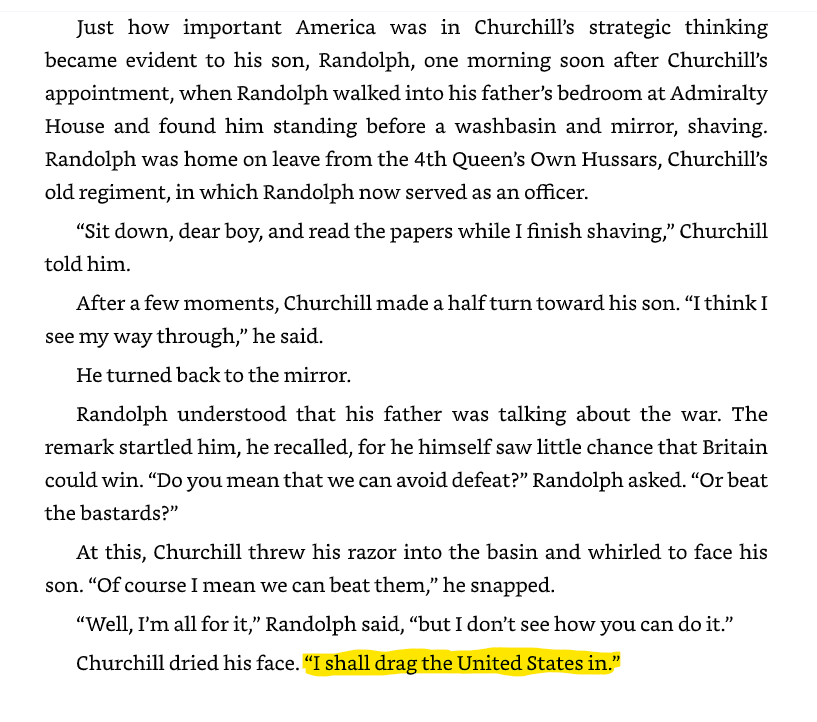
Yes, Pearl Harbor was the trigger, but it was more of a straw that broke the Isolationists’ stance. And look at how Churchill, who had been foreplaying America for a while by then, took the news when Pearl Harbor happened – relieved, saved, and thankful. Hitler’s declaration of war on America was just the cherry on top.
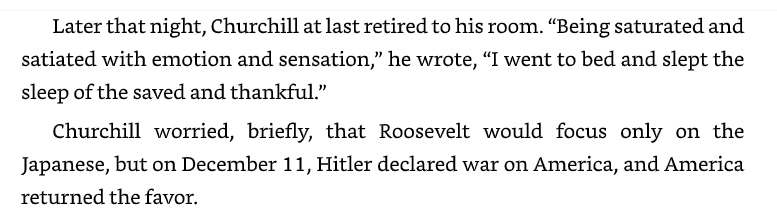
However, Britain itself wouldn’t be in the war or would have lost it without a battle had it not been for the grit, stubbornness, and sheer force of will that Churchill summoned when Dunkirk happened. They would have lost their entire army of 400,000 in France had he heeded what everyone around him – including Chamberlain, the House of Lords, big business and even the Royalty, told him to do. They wanted to stand down and negotiate terms with Hitler. And Churchill was staunchly against appeasement. His dogged insistence and uncompromising ambition to defeat the Nazi expansion led to the miracle at Dunkirk, where he surprised even himself. He had expected to rescue only 20,000-30,000 men from Dunkirk. But, roused by his inspiring speeches, optimism, and courage, civilians risked their lives by taking their private boats and vessels across the English Channel and into the battle-front. They ended up rescuing over 330,000 soldiers from Dunkirk. An entire army that later fought the biggest battles in the war would have been lost had it not been for Winston Churchill’s bullish persistence. That’s the racist Winston Churchill for you, and these are just two episodes of his tenure.
So yes, we Indians owe our current reality to the War and its players, including Churchill. Sure, our pacifist national leaders would have wiggled out new terms sooner or later. Subhash Chandra Bose’s INA would have succeeded in invading India with Japanese help, or the Naval Mutiny would have lit up a powdered keg. But the British would likely have been strong enough to counter it all if they hadn’t emptied their (and our) coffers for the war effort. In any case, that wouldn’t be the world we are in today.
All this is to say that knowing the complexities of the history of a “simple” war such as World War II is not just fun but also essential and valuable. If we appreciate how layered a “simple” war can be, we may think twice about making our minds up on the convoluted conflicts we see around us today. Today’s wars are multigenerational, messy, and chaotic. They have players of vacillating loyalties, generous interest groups, hidden lobbies, and greedy industries, not to mention the ‘deep states’ in each country and their malicious use of AI, drones, and the Internet. WWII gives perspective. In fact, all history does. It teaches about context and how multifaceted historical personalities use it to base their decisions. Today, we pass binary judgments on current & historical figures to suit our political narratives. History tells us to stop. Or to read it more.
For now, let us celebrate The Second World War. It gave us templates for not just things to look out for, like fascism, but also for other -isms that we should aspire for, capitalism, liberalism, constructivism, and so on. It gave us our vocabulary so we could argue about politics.
And yet, it is a simple war. It has definite start and end dates, well-documented causes, uncomplicated morality, and clear stakes. It has a good side and an evil one. It has a happy ending, with some nice lessons. And it is an enjoyable one!
Want to play some Call of Duty?

 MY AGLETS
Leave a reply to Harsha Cancel reply