(Opinions expressed are that of an evolving human being and therefore are subject to change with age, maturity, knowledge, experience, circumstances; or with what the writer has eaten on a particular day or even how full he is when prodded. The writer will not entertain “But you said so in <insert_MMDDYYY>” arguments in the future.)
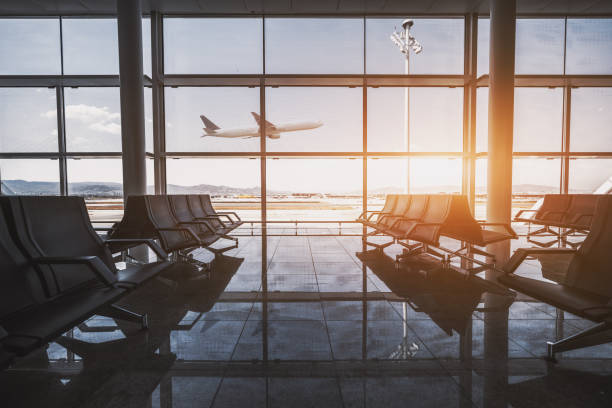
I am not a fan of traveling. I don’t hate it, but I don’t get the love for it that I see marketed to us on social media, by friends, or by companies. Sure, I do love to see a nice new place occasionally. But if someone were to tell me that I’ll live another fifty years and those will be confined to either Denver (where I live) or Nagpur (my hometown), I will probably shrug and say, “Oh, okay, it is sad, I guess. Anyway, what else is up?”
But I do love romanticizing airports (and airplanes when they’re not trying to shake my heart out of me). I find modern air travel to be a marvel. And that is not just because of comforting books like ‘Cockpit Confidential‘ or what Louis C.K. says in this clip here, which is superb by the way. Check it out:
Apart from what he said about air travel being a technical miracle, airports in themselves are such underrated places.
They are never the destinations themselves. Instead, they occupy a transitional and strictly functional space between arrivals and departures, always acting as the vertices or cusps of our travel, essential but taken for granted. Like handles on a suitcase, they are invisible-unless-broken. Thinking about how they bookend so many important life events, we realize that they are also the best place to think about Sonder – “the realization that each random passerby is living a life as vivid and complex as your own—populated with their own ambitions, friends, routines, worries and inherited craziness—an epic story that continues invisibly around you like an anthill sprawling deep underground, with elaborate passageways to thousands of other lives that you’ll never know existed, in which you might appear only once, as an extra sipping coffee in the background, as a blur of traffic passing on the highway, as a lighted window at dusk.”
It’s the realization that of the 7.9 billion human stories in existence, we are background extras in 7899999990 of them, supporting characters in about 9, and the protagonist of only one, our own. It is the feeling that there are deaths and weddings and reunions and holidays that are just as important as the ones we are traveling for, and that’s a solid enough reason to be a little kinder and considerate, especially where being curt and irritable is easy. Another reason to be so is the alone-ness. Though crowded, airports only entertain people who need the space, and thus, many of us find ourselves being the most lonely we have been in a while, as we pass through security stations.
We can argue why we sometimes experience them as anxiety-inducing, unfriendly, unhygienic, wasteful places, devoid of any real connections. But they do offset their weariness by their invisible efficiency. I feel that our negative experiences and fatigue with the very idea of airports may all be functions of the state of our minds more than the state of the airports themselves. Stress sours even the best experiences. The concentration of thousands of worried minds is bound to make everyone unlikable if not inaccessible, no? All the things that can go wrong individually often make us oblivious to the things that are working right as a system. What we experience on the surface is just the tip of a gigantic human and industrial enterprise that functions like clockwork, making a million human connections possible every single day. And beyond that fog of cacophony, the stress of missed flights, the chaos of lost baggage, and the understandable frustration that comes with timings, connections, and unending tests of tolerance, lies a marvel wherein tens of thousands of metal containers can transport hundreds of thousands of people across the planet.
I also like them because they are a microcosm of the human experience. They are a coagulated bundle of all human emotions stripped down to their raw form, in a finite and interchangeable space. The moment one steps inside the airport, the rest of the planet might as well fold itself up till its curb. In (metaphysical) theory, the airport exists on its own. Because everything outside is available inside, albeit in its concentrated form. Stress, being the most common emotion there, easily multiplies. But with the multitudes of and within people (thanks, Amit Varma/Walt Whitman), we also sense other emotions gaining power. Things on the edge flirt with falling off it, and things in control veer towards the boundaries.
A small digression. Visiting libraries or temples is rare for me and many of my generation. So, although ironical, it is obvious that in all their chaos, airports are where we see more people giving in to those quieter emotions, like being by themselves, reading, praying, sometimes contemplating. And speaking of temples, pseudoscience often attributes the power of a place of worship to the concentration of so many hopes, dreams, prayers, and wishes at a single location. They posit that it somehow manifests as a collective knock on the door of the divine. If that’s the case, then the arrival and departure halls at an airport, sometimes adjacent to each other, would be the most persuasive places for channeling not divine, but human gratitude.
The energy of reunions in the ‘Arrivals’ Hall is infectious, intensified with all the tight hugs, happy tears, and cries of joy. Only a few hundred meters away is the ‘Departures’ section where the mood is palpably somber yet equally intense. While one hand prevents the sniffles from becoming the sobs here, the other hand waves in the hope that it is being seen still, long after the people who are leaving have shoes and belts to remove and bags to open. The searching eyes that sift through faces looking for familiarity belong to both areas. And yet, they are ablaze with anticipation of the first glance in the arrivals one, and wide with the yearning of one last look in the other. If there is a commonality, it would be in the aforementioned gratitude that people feel in both these places; for the time with their loved ones that they have spent or are planning to spend.
Airports are also cities in themselves (not looking at you, Pune Airport), where people can spend entire lives, as they support at least the bottom four levels of this modified Maslow’s hierarchy. The top three are anyway rarer in the rest of the world.

Between all the emotions, the chaos, the efficiency, and the consumerism, there’s also the People-Watching. That there’s a specific term for something this universal was surprising to me when I first heard it from a colleague some years ago. He had said that he shops for groceries on early weekend mornings to enjoy the activity called people-watching. Large grocery stores do have an equalizing power. The confident and the insecure, the sorted and the confused, all are equally zombified as they walk around searching for the right product in the right aisle, deaf and blind to everything and everyone else, full only of “sorry”s and “excuse-me”s. But with all due respect to the stores, I think Airports offer a better view to ponder about universality and humanity (if we have the time to look up from our phones).
Walk between those shops among the harried-looking families and notice how the eye-popping colors drive the eyes and keep them darting from text to text – from glitzy shops in one blink to crucial signboards in another. Sneak a look at that parting couple stealing final kisses and expend a thought to bless the relationship. Feel a little smug looking at that businessman desperately fighting the internet connection to send one last email before he boards. See that group of newly 21 college kids eying the duty-free section and smile reminiscently about your own 21st. Feel a little pity for those tired eyes of fathers carrying a pink plush toy while their little one naps on their shoulders. Find that mother with little travel experience trying to calm a bawling little human while being embarrassed by the security personnel inconsiderately unpacking her loosely arranged bags. Offer some help. Make sure you notice that elderly woman pulling out her half-sewn sweater and remember your grandmother knitting one for you. And don’t, for heaven’s sake, forget checking out that girl sitting there, revealing nothing but her peculiar nerd interest by continuing with a half-finished novel, one that spikes your curiosity in her and the book in equal measure. Last, when you’re at the gate, see those hundreds of lonely faces illuminated in the lights of their phone screens as they peer into social media, messages, and videos. Among them you will find a few with headphones on, tapping their feet to inaudible beats. Finally, smile at those countable few who are disconnected, and yet are very much in the moment, just like you. You guys, although perhaps 8 in a hundred, can exchange knowing glances for you’re the ones looking up and watching instead of looking down and seeing. While everyone else is connected outside, you have an unspeakable connection with those by themselves. Plus, in the rare instances when the flight changes appear on the boards before they are announced, the eight of you will have a head start towards the new gates.
The flights then place us in temporary limbos, thereby allowing the travel to not just be limited to the physical realm. Children look outside the windows to peer farther, and adults do the same to look deeper. Many people, including me, are happy to not use the complimentary Wi-Fi on flights. We’re glad to be forcibly unplugged from the dings and chimes of notifications. Sleep isn’t really fulfilling, and it isn’t comfortable, but it is calming. Sometimes we finish a good book. Sometimes there’s a new friend we make en-route. But mostly we’re by ourselves, in ourselves, crossing time zones and topographies, challenging our circadian cycles, only to land back in the haste and the chaos of another airport.
The best (or the worst) part is that all airports are the same. They’re made the same so that they’re universal in their signage and their instructions, of course. But they may even be the same single airport occupying the same spatial dimension, and we would never find out. The rest of the world is still folded in on its own at the curb, remember? Who’s to tell a Tattered Cover at the Denver Airport from a Hudson Bookseller at Newark’s? Who can distinguish between a whiff of brewing Mocha Latte at LA and a spilled Latte Macchiato at Paris? Or between Gate C112 and Terminal B5? What’s there to tell you’re in Chicago or Madrid, apart from some window dressing? When we land and deplane and walk towards our connecting flights, who’s to say that we haven’t landed back among the same concrete slabs and the exact same and slightly rearranged maze of shops, chairs, walkways, restaurants, bathrooms, meditation rooms, clubs, and lounges? They’re the same sights, the same smells, and thanks to Brian Eno I guess, even the same sounds.
Same are the people too – the business class snobs are not better or worse between a Heathrow or a Doha. Of course, when we travel in business classes ourselves and get to settle in the first few rows, we perhaps look just as arrogant and pretentious to those poor souls passing us with judgmental looks, hauling bags and babies to the back of the plane. Regardless of class, we’re united in the blessings, regrets, longings, wishes, confusion, anger, and hopefully, the best kind of sorrow, that of missing the people we leave behind. The fears and frustrations are the same too. A sudden lurch mid-flight does not discriminate between classes and nor do the delays or the detours. Each person would betray their raw emotions to some extent when these unifying things jolt them into being human beings instead of being ranks, executives, salesmen, or creators.
At airports, there are fewer distinctions. Same bathrooms, same queues at shops, same places to wait. The baggage belts don’t discriminate either. Even the people in the so-called Priority Lanes seem restless and anxious, it is just that perhaps their impatience is short-lived. Transit lounges are comfortable for those privileged enough to enjoy them, but flatter seats and warmer coffees can only placate the external discomforts. Those with loving families and long-awaited reunions on their minds are excited and bouncy even if they must sit on the floors. And those unfortunate to be battling dreadful thoughts or events can be miserable in the coziest of chairs.
All this impartiality lasts only till we step out of the airport into the real, outside world which unrolls like a carpet, ready for us. As we wait on the curb, the lucky among us go back to their gifted existence and private chauffeurs. For the rest of us, the smells of the city fill our noses as we wait for cabs and friends. The trip begins now, we think, in dread or anticipation based on the reason for our travel. And just like that, the memories of the airport get buried in the ground reality of sightseeing, or work, chores, meetings, commute etc. Even vacations are brimming with catching reservations and the constant planning and improvising, not to mention the posing and the uploading.
We may be in comfortable offices and quiet cars, or at scenic sunsets or amazing drives, but the inner silence of the flights and the forced inactivity and hibernation that we felt at the airports cannot be replicated when we’re living on batteries of purpose.
And that is why, I am not as fond of traveling as I am of having traveled through an airport.
-Prasanna
 MY AGLETS
Leave a comment