(It feels callous to have this as the title of a post discussing what they called the Marshall Fire. But it is apt, and is not meant to trivialize the incident.)
Just before the end of the year (2021), I decided to start writing every single day of 2022. There are no significant changes to lifestyle, no other major resolutions that need a place or time. Just this: WRITE>EVERY>DAY. So here’s just a blog entry for day 3…

Since I have no movie review today (unlike the first two days of this year), I want to explore a feeling I have been suppressing since the year began, about how we felt entering 2022 the way we did. Survivor’s guilt is perhaps what I can box it as. But it isn’t guilt as much as it is just a small sliver of shame over the fact that we could celebrate the coming of 2022, that we could make resolutions, that we were together, warm and happy, while people around us, people less than 50 miles away from us had their lives and everything in it snatched from them.
We live in Broomfield, Colorado. On the 30th of December 2021, nearly a thousand houses, just like ours – full of Christmas decorations, holiday lights, large families, children, grandparents, food, gift boxes, and laughter – caught fire and were burned to the ground. They are still investigating the cause. But unlike forest fires of the Californian summers, this was a suburban fire, one that charred more houses than trees. Luckily, they estimate only two casualties as of Jan 3rd, 2022. I say luckily because the burn spread across 6000 acres of suburbs and dry grasslands in a span of 8 to 9 hours. Entire communities, rows after rows of houses, as the drone footage later showed, were leveled to white ash, with just the concrete basements full of burned remains still standing.
We were about 20 miles from the fire and could see the flames in the distance. Around 3 p.m., we saw the flames and the dark smoke that had curtained the horizon, and immediately packed our bags with essentials – clothes, medicine, documents, valuables, and so on. We got in our cars and headed to a friend’s place further east for a few hours. For the remaining part of that day, the thought of losing our new house crossed our minds several times.
We kept refreshing Twitter and the TV news, as town after town sat in the path of the fire like little dots line up in front of the all-consuming Pac-Man. The tweets, instructions, and maps online were being updated in real-time and posts like – “Evacuate the town to Superior”; “Residents of Lousiville now asked to evacuate”; “Broomfield in pre-evacuation yellow”; “Arvada now in red (mandatory evacuation)”; Hospitals emptied; Jail inmates moved to another secure facility; department stores shut down with shoppers narrowly escaping, their masks serving a second purpose of saving them from the smoke and the soot; Notices of elderly people missing; and the screams of firetrucks as they sped in all directions trying in vain to fight the 100 mph unruly winds fueling the destruction – were the only things we saw, read, and heard for hours on end that day.
We returned home in a few hours but kept the blinds open all night to keep an eye on the fire. I looked up on Reddit and some advice suggested taking pictures of the rooms in the house to have it handy when it is time to claim insurance. We did that. When we went to bed, still wearing our jeans and with one eye on the window, we mentally walked through the house to make a list of all the items we owned. The packed bag lay ready at the foot of our beds. We woke up every few hours throughout the night to look at the window to see if the flames had gotten any closer. They did not.
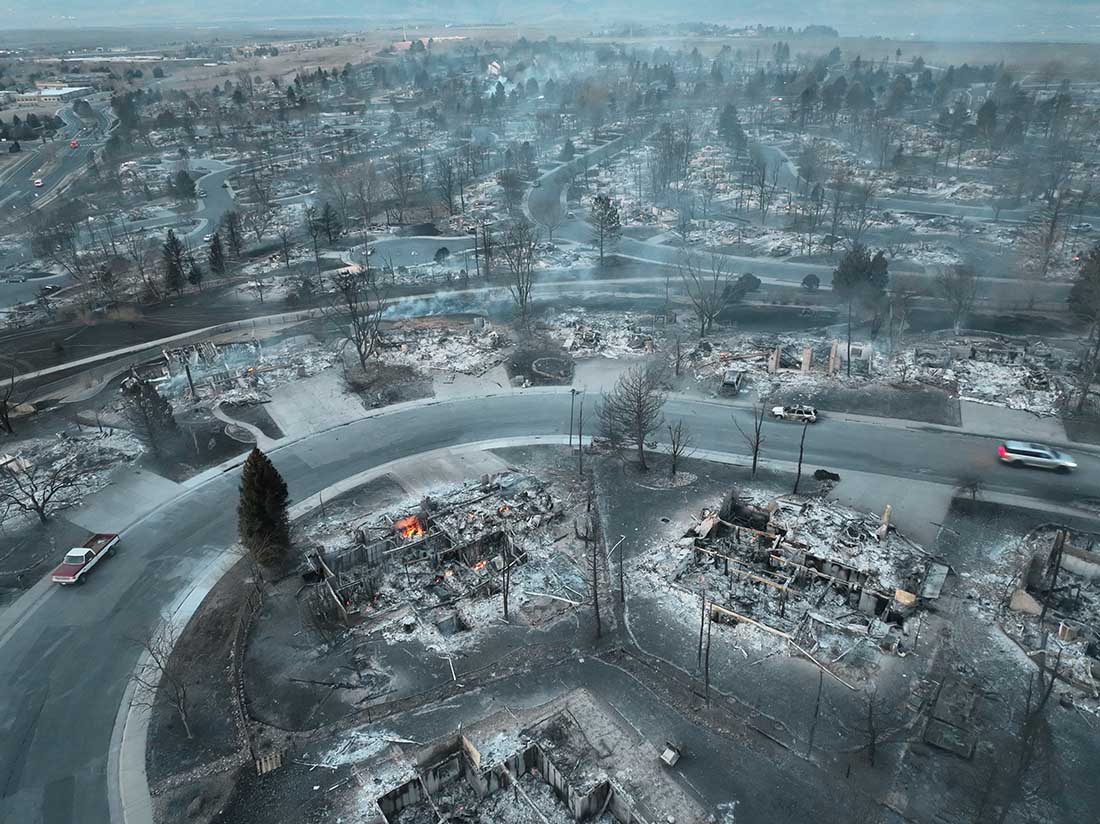
The next day, by the time the smoke had cleared, the snowstorm’s arrival was celebrated even more than it would have been without the fires. Denver had never seen snow start this late in the season, in my ten years in Colorado. It came as a blessing, dousing fires as it blanketed the area. A few hours later, it was time to celebrate New Year’s Eve with a pizza and Pepsi. And that was that.
But every time we replied to a text about the new year, or said things like “phew, that was close”, we could not avoid thinking about how near we came to losing everything. We were fortunate enough to be able to celebrate the arrival of 2022. A lot of people, a thousand families near us, spent NYE huddled in makeshift shelters and waiting on calls to hear back from their insurance agents. We could return home the same day, but those thousand families didn’t have a home left to return to. We could say the snow helped fight the fires. But the snowstorm made living conditions worse for those affected by the fire, those who were rendered homeless overnight. How easy it was, we thought, to be panicking one moment, and then celebrating Dec. 31st in a few hours just because our communities were spared. How amnesiac are humans? Or is it just us who were this shameless? Would we be this normal had there been a proportionate loss of life? Destruction of property is always cushioned by things like “well, at least we didn’t lose people.” On the one hand, it is an appropriate response, as human life does supersede material wealth.
At the same time, imagining losing our house was an exercise in practicing pragmatism in the face of a damaged past and a blank future. We calculated insurance premiums and tallied up costs of items in our house, while also thinking of how big a dream the house was for us. It would have taken months if not years to own another one. Even if we forget about owning another home, we would need to rebuild our lives, from buying spoons and plates to mattresses and clothes, to say nothing of the pause on other larger plans, family trips, and career moves. We came so close to our lives being upended that imagining the consequences isn’t that difficult anymore. Yes, loss of life would’ve been worse. But we shouldn’t forget that loss of property is traumatizing and not insignificant for those who face it, howsoever stoic they’re forced to be, howsoever grateful they’re made to be about the fact that they are alive.
There are stories of first responders who lost their own homes trying to save lives. There are stories of firefighters working all night long in freezing cold trying to douse haphazard fires. There are posts about helpful people offering their own homes to those affected. We would have loved to do that for someone were we not diagnosed to still be Covid-positive (as of last Thursday).
All said and done, what’s the lesson? I think the lesson is that we should be pushing for climate change-related legislation harder than we are. The winds, with speeds over 100 mph in places, were responsible for making the situation worse than what it already was, a terrible concoction of (un)natural weather patterns at the local level, lazy and unevolved construction practices at the national one, and most importantly, the global neglect (if not denial) of climate change. Had the state seen any snow when it is supposed to – late Oct. to early Nov – the ground wouldn’t have been this dry. The fire would not have spread this fast regardless of how stormy the winds were. Colorado is inching towards a climate-change-induced drought, something that parts of California and Arizona have already started experiencing. The Arkansas and Colorado rivers’ water levels are at an all-time low. Farmers have been told about irrigation bans in Arizona and western parts of Colorado.
It seems like, within our lifetimes, we would officially become climate refugees. The planet will survive and so will humans. Being privileged, we may even come out unscathed. Perhaps we will overcrowd in Canada and Siberia. But the climate apocalypse will come, even though it won’t be a sudden big event. It will be sporadic, random, in bits and pieces, here and there, in fires and floods, in unnatural snows, unseasonal rains, and unpredictable weather patterns. The world won’t end all at once, but a thousand houses at a time. All we can do is prepare.
 MY AGLETS
Leave a comment